

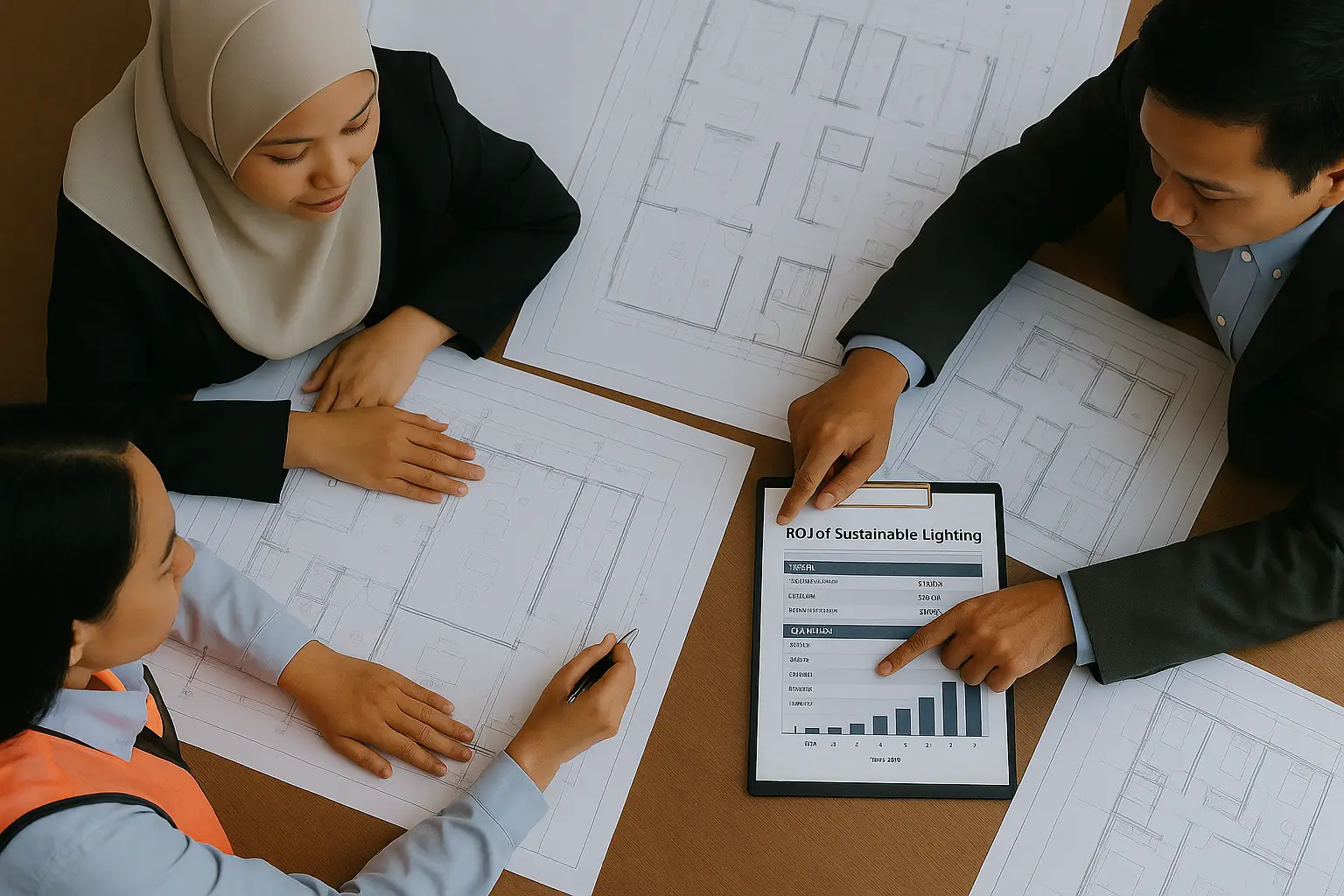

Lighting upgrades aren’t just about going green — they’re about saving serious money.
Businesses can cut energy bills by up to 70%, reduce maintenance costs by half, and recoup their investment in as little as 12 to 24 months with sustainable lighting design.
This guide breaks down the exact numbers behind LED and smart lighting systems — from energy savings and rebates to ESG incentives and payback periods. Whether you’re managing a retail space or planning an office retrofit, this article shows you how to calculate real-world ROI.
Why ROI Matters in Lighting Design Decisions
Lighting can account for up to 40% of a commercial building’s electricity use. That makes it one of the easiest and fastest ways to reduce operating expenses.
But these savings don’t happen by accident — they start with intentional lighting design that aligns layout, controls, and fixture types with your space’s actual usage patterns.
A well-designed sustainable lighting system delivers:
While upfront costs may seem higher, the long-term ROI often outperforms traditional systems — especially when you factor in rebates, tax incentives, and lower operational overhead.
Upfront Investment vs Lifetime Value
Switching to sustainable lighting requires an initial capital outlay — but the total cost of ownership is significantly lower.
Fixture Cost Comparison (Per Unit)
Fixture Type | Average Cost | Average Cost | Wattage |
|---|---|---|---|
Incandescent | RM4 | 1,200 | 60W |
Fluorescent | RM10 | 15,000 | 32W |
LED (Eco) | RM25 | 50,000 | 10W |
Over its lifetime, one LED can replace up to 40 incandescent bulbs — dramatically reducing both purchase and disposal costs.
Installation and Design Costs
Rebates and Subsidies in Malaysia
These rebates can offset up to 30–50% of the initial cost — dramatically shortening the payback period.
Energy Savings Over Time
Sustainable lighting systems dramatically cut electricity consumption — especially when paired with automation.
Typical Energy Use (Per Fixture, Per Hour)
Fixture Type | Wattage | Energy Cost (RM/kWh) | Cost per 1,000 hrs |
|---|---|---|---|
Incandescent | 60W | RM0.50 | RM30 |
Fluorescent | 32W | RM0.50 | RM16 |
LED (Eco) | 10W | RM0.50 | RM5 |
Switching to LED can cut lighting energy costs by 70–80%.
Savings from Smart Lighting
In typical commercial spaces, energy savings can reach RM3–RM6 per sqft annually, depending on usage hours and system design.
Maintenance & Replacement Cost Reductions
LED fixtures drastically reduce the cost and hassle of replacements and repairs.
Lifespan & Maintenance Comparison
Fixture Type | Lifespan (Hours) | Replacements Needed (Over 10 Years) |
|---|---|---|
Incandescent | 1,200 | ~8–10 |
Fluorescent | 15,000 | ~2–3 |
LED (Eco) | 50,000 | 0–1 |
Key Maintenance Advantages
Businesses often see 40–60% savings on maintenance budgets alone after switching to eco lighting systems.
Indirect ROI: ESG Compliance and Brand Image
Sustainable lighting doesn’t just cut costs — it elevates your company’s standing in the eyes of stakeholders, investors, and customers.
1. ESG Scoring and Regulatory Benefits
Learn more about how lighting upgrades help with ESG reporting here.
2. Tax Incentives and Green Financing
3. Brand Perception & Market Advantage
These factors translate to competitive advantage, easier capital access, and improved stakeholder trust — all crucial for long-term business resilience.
Tools to Calculate Your Own ROI
You don’t need to guess how much you’ll save — ROI calculators can give you a clear picture before you invest.
Basic ROI Formula for Lighting Upgrades
ROI (%) = [(Annual Savings – Annual Costs) ÷ Initial Investment] × 100
Payback Period (Months) = Initial Investment ÷ Monthly Savings
Use this to estimate how quickly your investment pays for itself — and how much you gain after.
What You’ll Need to Plug In
They use a few key inputs to estimate your return:
How The Formula Works
Step | Formula | What It Means |
|---|---|---|
1. Old Energy Use | (Fixtures × Old Wattage × Hours × Days) ÷ 1000 | Total kWh/month before |
2. New Energy Use | (Fixtures × New Wattage × Hours × Days) ÷ 1000 | Total kWh/month after |
3. Monthly Savings | (Old kWh × Rate) – (New kWh × Rate) | Cost difference |
4. Annual Savings | Monthly Savings × 12 | Yearly benefit |
5. Investment | (Fixtures × LED Cost) + Installation – Rebate | Net upfront cost |
6. Payback Period | Investment ÷ Monthly Savings | Months to break even |
7. ROI (%) | ((Annual – Investment) ÷ Investment) × 100 | Return after year one |
Example: 100 fixtures switched from 32W to 10W LEDs save ~RM330/month. With a RM4,500 investment, the system breaks even in 13.6 months and yields 88% ROI in the first year.
Try It Yourself
[Download the Excel ROI Calculator] or [Use Our Online Tool]
The more accurate your input, the better your savings forecast — making it easier to secure internal buy-in or justify project budgets.
Real-World Case Example: Office Retrofit
A recent retrofit project with a mid-sized office in Kuala Lumpur illustrates just how impactful sustainable lighting can be.
Client Snapshot
Before vs After
Metric | Before Upgrade | After Upgrade |
|---|---|---|
Monthly Energy Bill (Lighting) | RM3,200 | RM1,200 |
Maintenance Intervals | Every 6–8 months | Once every 3 years |
Payback Period | — | 16 months |
ESG Score Contribution | None | +8 points |
This single retrofit saved the company over RM24,000 per year — with added benefits to their ESG reporting and employee comfort.
When Does Sustainable Lighting Pay for Itself?
The average payback period for a commercial lighting upgrade is between 6 months to 3 years, depending on your setup and usage.
Key Factors That Affect Payback
CAPEX vs OPEX: Which One Pays Off?
Cost Type | Traditional Lighting | Sustainable Lighting |
|---|---|---|
CAPEX | Low upfront cost | Higher upfront, offset by rebates |
OPEX | High monthly energy + frequent maintenance | Low operational cost |
Over time, sustainable lighting shifts your spend from reactive maintenance to proactive savings — with returns compounding every month.
Ready to Maximize Your Lighting Investment?
If you’re planning a retrofit or new build, the numbers are clear: sustainable lighting pays for itself — and keeps delivering.
Let’s design a system that reduces your costs, boosts ESG scores, and lasts for years.
Already exploring rebate options? Our guide breaks it all down:
Lighting is often the simplest upgrade to make — but the impact runs deep when done right.
Let’s wrap up with why this matters now, and what’s at stake if you wait.
Key Takeaways: Strategic Gains with Measurable Impact
Lighting upgrades are more than an energy-saving measure — they’re a direct lever for ESG performance. They reduce Scope 2 emissions, lower operational costs, and deliver clean, trackable data that aligns with major ESG frameworks.
Unlike larger infrastructure changes, lighting retrofits are quick to implement and offer immediate results — from environmental impact to employee wellbeing. Most importantly, they show stakeholders that your company takes sustainability seriously, with actions backed by metrics.
If you want to make visible, reportable progress on ESG — lighting is the place to start.