

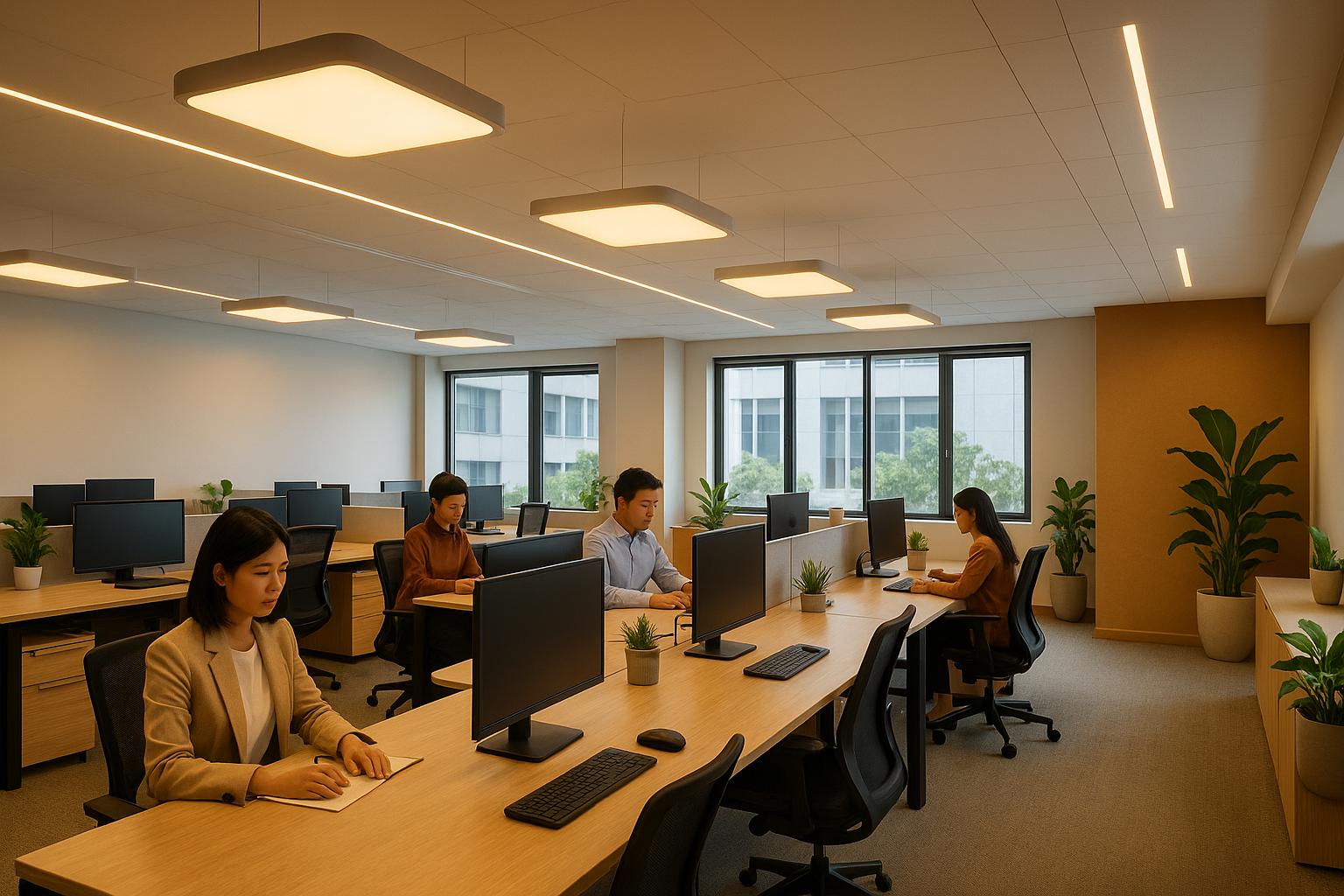

Smart lighting is transforming Malaysian offices, combining energy savings with employee well-being. Rising electricity costs and ESG compliance pressures are driving businesses to adopt advanced lighting systems. These systems integrate IoT, AI, and sensors to improve workplace comfort, reduce energy usage, and provide centralised control.
Here’s a quick overview of the top trends reshaping office lighting:
- Human-Centric Lighting (HCL): Mimics natural sunlight to support circadian rhythms, improve health, and boost productivity.
- IoT-Connected Systems: Enables real-time monitoring, remote control, and automated adjustments for better energy management.
- Motion-Sensing Controls: Automatically adjusts lighting based on occupancy, reducing waste and improving convenience.
- AI-Powered Lighting: Learns and predicts usage patterns, optimising energy consumption and enhancing comfort.
- Daylight Harvesting with Smart Glass: Balances natural and artificial light while reducing cooling loads in Malaysia’s tropical climate.
These solutions not only cut costs but also support ESG goals with features like energy monitoring, reduced carbon emissions, and sustainability reporting. Companies like Justlight Concept offer tailored systems to meet Malaysia’s unique office needs.
IoT-Enabled Smart Lighting for Commercial Space
1. Human-Centric Lighting (HCL) for Employee Health
Human-Centric Lighting (HCL) shifts the focus from standard office lighting to systems designed with employee wellbeing in mind. By mimicking the natural rhythm of sunlight through dynamic changes in brightness and colour temperature throughout the day, HCL helps maintain circadian rhythms – even in spaces without windows. This approach not only supports employee health but also promotes better productivity and energy efficiency.
HCL systems typically begin the day with cool, bright light to boost alertness, gradually transitioning to warmer tones as the day progresses. This shift reduces eye strain and aligns more naturally with the body’s energy cycles.
Employee Well-being and Productivity Impact
Aligning indoor lighting with the natural day–night rhythm can significantly reduce eye fatigue and improve sleep quality. This is particularly relevant in Malaysia’s bustling urban centres, where employees often spend long hours under artificial lighting. By addressing the dreaded afternoon energy slump, HCL systems help maintain focus and reduce the need for coffee breaks or other stimulants.
In addition, these systems tackle common problems linked to poor lighting, such as headaches, dry eyes, and general fatigue. The result? Fewer sick days, improved job satisfaction, and a more energised workforce.
Compatibility with Malaysian Office Conditions
Malaysia’s consistent daylight hours create an ideal environment for HCL implementation. Unlike countries with drastic seasonal changes, Malaysian offices can benefit from predictable sunrise and sunset times, making it easier to establish steady lighting schedules.
Many office spaces in Malaysia rely heavily on air conditioning and often use tinted windows that limit natural light. HCL systems can fill this gap by providing a balanced light spectrum that compensates for reduced natural illumination. In high-rise buildings, where sunlight exposure varies by direction, these systems can be customised. For instance, areas with less sunlight may use cooler tones throughout the day, while others adjust dynamically to maximise available daylight.
Energy Efficiency
HCL systems are not just about wellbeing – they’re also energy-efficient. Using LED technology and smart controls, these systems consume less power and can lead to noticeable savings on electricity bills. Many are equipped with sensors that automatically dim lights when there’s sufficient natural light, further reducing energy use. This feature is especially beneficial in Malaysia, where abundant daylight can complement artificial lighting.
Support for ESG Goals and Sustainability Reporting
HCL systems also align with corporate sustainability goals. They provide measurable data on energy use, carbon emissions, and employee wellness – key metrics for companies aiming to achieve green building certifications or meet sustainability targets. By demonstrating a commitment to environmental responsibility and employee health, businesses can strengthen their sustainability reports.
Additionally, LED-based HCL systems require less maintenance, reducing waste from frequent bulb replacements and conserving resources.
For Malaysian businesses looking to improve workplace wellness while reducing energy consumption, Justlight Concept offers tailored lighting solutions that combine these human-centric features with sustainable design. This blend of employee wellbeing and energy efficiency helps create a more sustainable and productive office environment.
2. IoT-Connected Smart Lighting Systems
IoT-connected lighting takes office illumination to the next level, moving beyond traditional setups. These systems link individual fixtures into a network, enabling real-time monitoring, remote control, and automated adjustments. Unlike standalone smart bulbs, IoT lighting creates a fully integrated ecosystem that works seamlessly with other building systems like HVAC, security, and facility management platforms.
By combining human-centric lighting advancements with IoT connectivity, these systems offer smarter, data-driven controls that integrate with overall building operations. Sensors embedded within the system continuously gather and analyse data, tracking energy use, space utilisation, and more. This gives facility managers deeper insights into their building’s performance, allowing for better decisions on energy management, space planning, and employee comfort.
Energy Efficiency
IoT lighting systems are a game-changer for energy savings, offering precise control and automated features that reduce energy consumption. Compared to traditional fluorescent lighting, these systems can significantly lower energy costs – an especially appealing benefit for Malaysian office spaces.
Key energy-saving features include occupancy and daylight sensors that adjust lighting based on real-time conditions. For instance, lights dim or turn off in unoccupied areas and adjust brightness levels during the day to make the most of natural light. Scheduling features ensure lighting operates only when needed, cutting unnecessary energy use during off-peak hours.
Real-time energy monitoring is another standout feature. Facility managers can track energy use down to individual fixtures, quickly spotting inefficiencies or faulty equipment. This level of detail not only reduces operational costs but also helps maintain optimal system performance.
Employee Well-being and Productivity Impact
IoT lighting systems don’t just save energy – they also create more comfortable and productive work environments. Employees can personalise their lighting through mobile apps or desk-mounted controls, adjusting brightness and colour temperature to suit their preferences. Meanwhile, the system works in the background, integrating with other building technologies to promote an overall healthier workplace.
For example, meeting rooms automatically adjust their lighting for presentations or collaborative sessions. In open-plan offices, distinct lighting zones adapt throughout the day – providing brighter light for focused tasks and softer, ambient light during breaks. This dynamic approach enhances comfort and supports productivity.
Additionally, motion detection ensures no area is left in darkness, improving safety and convenience. By blending smart technology with thoughtful design, these systems help create workplaces that prioritise both efficiency and employee well-being.
Compatibility with Malaysian Office Conditions
Malaysia’s tropical climate and consistent daylight hours make it an ideal setting for IoT lighting. With roughly 12 hours of daylight year-round, these systems can use daylight harvesting features to minimise artificial lighting during peak daylight hours. This is particularly useful in offices with abundant natural light, where energy savings can be maximised.
IoT lighting also addresses challenges unique to Malaysian offices, such as high humidity and temperature fluctuations. Modern systems use LED technology, which not only performs well in tropical conditions but also generates less heat than traditional lighting. This reduces the strain on air conditioning systems, a major energy consumer in commercial buildings.
Many Malaysian offices feature large windows to maximise natural light, which can sometimes lead to glare. IoT lighting systems automatically adjust brightness and direct light to reduce glare, working effectively with tinted glass commonly used in high-rise buildings. These adaptive features ensure consistent, comfortable illumination no matter the external conditions, while also supporting energy efficiency.
Support for ESG Goals and Sustainability Reporting
IoT lighting systems play a crucial role in supporting environmental, social, and governance (ESG) goals. They collect detailed data on energy use, carbon emissions, and operational efficiency – key metrics for sustainability certifications like the Green Building Index (GBI) or LEED.
With automated reporting features, these systems eliminate the need for manual data collection, tracking metrics such as kilowatt-hours used per square metre and reductions in carbon footprint. This data integrates seamlessly with corporate sustainability platforms, making it easier for businesses to demonstrate their commitment to environmental responsibility.
These systems also align with circular economy principles by enabling predictive maintenance. By monitoring fixture performance and forecasting potential issues, they help extend the lifespan of equipment and reduce waste from premature replacements. This proactive approach not only supports sustainable resource management but also ensures long-term operational efficiency.
3. Motion-Sensing and Automatic Lighting Controls
Motion-sensing technology has become a practical solution in smart office lighting, utilising tools like passive infrared (PIR) sensors, microwave detectors, or dual-technology sensors. These systems detect movement to automatically control lighting fixtures, offering features like adjustable sensitivity, programmable delays, and seamless integration with building management systems. Lights turn on when motion is detected and dim or switch off during inactivity, helping conserve energy while maintaining flexibility in operations.
Energy Efficiency
These systems are designed to save energy by ensuring lights are only active when spaces are occupied. This is particularly useful in areas with irregular use, such as meeting rooms, storage spaces, hallways, and washrooms, where lights often remain on unnecessarily. When paired with photosensors, the system adjusts artificial lighting based on the amount of natural light available, further improving efficiency.
Employee Well-being and Productivity Impact
Automatic lighting controls remove the hassle of manual adjustments, ensuring spaces are always well-lit when in use. Proper lighting reduces eye strain and promotes visual comfort, allowing employees to stay focused on their tasks. In dynamic office setups with hot-desking, meeting rooms, and collaborative spaces, motion sensors ensure that each area is illuminated as required, enhancing overall comfort and productivity.
Compatibility with Malaysian Office Conditions
Malaysia’s tropical climate and modern office designs make motion-sensing lighting especially effective. These sensors are built to function reliably even in challenging conditions, while Malaysia’s consistent daylight hours allow systems to be programmed based on predictable sunrise and sunset times. In open-plan offices, zoned motion detection ensures that only occupied sections are lit, maximising energy efficiency.
Support for ESG Goals and Sustainability Reporting
Motion-sensing lighting systems contribute to sustainability efforts by automatically collecting data on occupancy and energy use. This data helps facility managers optimise space utilisation and identify further energy-saving opportunities. Additionally, these systems enhance workplace safety and employee well-being, aligning with the broader goals of ESG (Environmental, Social, and Governance) strategies.
For businesses ready to upgrade their lighting systems, Justlight Concept offers customised solutions. Their services combine smart control systems with energy management expertise, maintenance support, and design tailored to meet the needs of modern Malaysian offices.
sbb-itb-f091f3d
4. AI-Powered Lighting Control and Energy Management
Building on advancements in IoT and motion-sensing technologies, AI-powered lighting takes things to the next level, making office lighting smarter and more responsive. Instead of just switching lights on or off, these systems use data and machine learning to adapt to how workplaces function. They can predict lighting needs, adjust brightness, and manage energy consumption – all without human input.
By integrating sensor data, modern AI lighting systems create tailored lighting profiles for specific areas, times of the day, or even seasonal changes. The result? A lighting environment that continuously adjusts to meet the needs of the space.
Energy Efficiency
AI lighting systems are game-changers when it comes to cutting down energy use. They don’t just turn off lights in empty rooms – they analyse historical data to fine-tune energy consumption. For example, they can dim lights in areas that are rarely used or adjust schedules based on calendar bookings to ensure energy isn’t wasted in unoccupied spaces.
Real-time monitoring adds another layer of efficiency. By tracking energy usage across different zones, facility managers can identify peak usage times and areas where improvements can be made. This kind of data-driven insight helps businesses make smarter decisions about their lighting systems.
Employee Well-being and Productivity Impact
AI lighting isn’t just about saving energy – it’s also about creating a better environment for employees. These systems can mimic natural light patterns, supporting circadian rhythms and improving overall comfort. For instance, they might provide cooler, brighter light in the morning to boost alertness and switch to warmer tones in the evening to reduce eye strain.
The system also adjusts lighting based on the task at hand. Work areas get brighter light to improve focus, while break areas are kept softer to encourage relaxation. Plus, it compensates for external conditions like cloudy weather or seasonal daylight changes, ensuring consistent lighting quality throughout the year.
Compatibility with Malaysian Office Conditions
Malaysia’s tropical climate and steady daylight patterns make it a great fit for AI-powered lighting systems. These systems can be programmed to work alongside the country’s natural daylight cycle, and they’re built to handle Malaysia’s high humidity and warm temperatures. With robust sensors and cloud-based processing, they perform reliably even in challenging conditions.
What’s more, integrating AI lighting into existing office setups is straightforward. Businesses can incorporate these systems into their current infrastructure without major overhauls. This is especially useful for the open-plan office layouts common in Malaysia, where zoned lighting can manage different areas independently while still keeping the entire system coordinated.
Support for ESG Goals and Sustainability Reporting
AI lighting doesn’t just benefit offices – it also supports broader sustainability goals. By automatically collecting and analysing energy data, these systems make it easier for companies to track and report on their environmental performance. This is particularly useful for meeting evolving ESG (Environmental, Social, and Governance) requirements.
Additionally, predictive maintenance features identify potential equipment issues before they escalate, reducing waste from unnecessary replacements and contributing to long-term sustainability efforts. This makes AI lighting a smart choice for businesses looking to align with sustainability initiatives.
For Malaysian businesses ready to explore AI-powered lighting, Justlight Concept offers end-to-end solutions. From system design to implementation and ongoing energy management, they help offices unlock the full potential of this technology while staying aligned with sustainability objectives.
5. Daylight Harvesting and Smart Glass Integration
Daylight harvesting combines the use of natural light with smart glass technology to create a more efficient and comfortable workspace. This system automatically adjusts artificial lighting based on the available sunlight, while smart glass regulates the amount of sunlight entering the office. Electrochromic glass, for instance, can switch from clear to tinted in moments, reducing glare and heat while maintaining pleasant light levels. Together, these technologies offer an effective way to save energy and reduce costs.
Energy Efficiency
In Malaysia’s tropical climate, daylight harvesting paired with smart glass significantly reduces energy use and cooling demands. Offices using these solutions see noticeable decreases in lighting energy consumption during the day. Smart glass also lessens the cooling load by automatically adjusting its tint during peak sunlight hours, helping businesses achieve faster returns on their investment.
Employee Well-being and Productivity Impact
Beyond energy savings, these systems promote employee well-being. By maintaining a light spectrum that closely resembles natural sunlight, they help regulate circadian rhythms, leading to more consistent energy levels and better sleep. Smart glass also minimises glare and visual discomfort by adjusting tint levels automatically. Employees can enjoy natural light and outdoor views without needing blinds or curtains, which enhances both comfort and productivity.
Compatibility with Malaysian Office Conditions
Malaysia’s steady daylight conditions make these technologies particularly effective. The intense tropical sun and frequent shifts in cloud cover require systems with advanced control capabilities. Modern daylight harvesting solutions are built to handle the country’s high humidity and temperatures of up to 35°C. Durable photosensors and real-time adjustments ensure seamless operation, even with rapid changes in outdoor light levels.
Smart glass is especially useful in managing solar heat gain. During peak sunlight hours, it automatically tints to reduce heat entering the workspace. This keeps the office comfortable, eases the strain on air conditioning systems, and maintains the benefits of natural light.
Support for ESG Goals and Sustainability Reporting
Daylight harvesting systems also align with environmental, social, and governance (ESG) goals. They provide detailed data on energy use and resource efficiency, allowing businesses to track improvements and reduce their carbon footprint. These technologies contribute to achieving green building certifications like LEED and the Green Building Index (GBI) by enhancing energy efficiency and maximising natural daylight usage. With their durable design and minimal maintenance needs, they also help reduce electronic waste, supporting circular economy principles.
For Malaysian companies aiming to adopt daylight harvesting solutions, Justlight Concept offers tailored design and installation services. Their expertise in sustainable lighting and energy management ensures these systems perform optimally in Malaysia’s unique climate while helping businesses meet their long-term ESG objectives.
Comparison Table
Here’s a breakdown of key smart lighting trends tailored for Malaysian office spaces:
| Smart Lighting Trend | Energy Efficiency | Employee Health Impact | Malaysian Office Compatibility | ESG Support |
|---|---|---|---|---|
| Human-Centric Lighting (HCL) | Moderate energy savings | Excellent: Improves circadian rhythm, reduces eye strain, and boosts productivity | High: Works well in tropical climates and addresses issues like limited outdoor exposure | Strong tracking for wellness metrics and energy reporting |
| IoT-Connected Systems | High energy savings through optimised control | Good: Supports personalised lighting preferences and reduces visual discomfort | Excellent: Ideal for multi-floor buildings with remote monitoring; handles humidity and temperature variations effectively | Comprehensive real-time energy monitoring and detailed ESG reporting |
| Motion-Sensing Controls | Very high savings by activating lights only when needed | Moderate: Maintains consistent light levels during occupancy and prevents over-illumination | Excellent: Perfect for offices with varying occupancy patterns and helps reduce unnecessary cooling loads | Provides essential energy tracking and aids in green building certifications |
| AI-Powered Control Systems | Highest efficiency through adaptive learning and control adjustments | Very good: Adjusts lighting for various tasks, enhancing comfort and productivity | Optimal: Seamlessly integrates with other building systems and adapts to local conditions | Advanced analytics for tracking carbon footprints; supports predictive maintenance |
| Daylight Harvesting with Smart Glass | High savings by blending natural light with smart control | Excellent: Ensures natural light exposure, regulates circadian rhythms, and minimises glare | Excellent: Designed for tropical climates to manage intense sunlight and rapid weather changes effectively | Detailed sustainability reporting and recognised building certifications |
The table highlights the strengths of each trend across energy efficiency, employee well-being, office compatibility, and ESG alignment. For instance, AI-powered systems lead in efficiency and adaptability, while daylight harvesting solutions expertly balance natural light use with reduced cooling demands. Meanwhile, human-centric lighting (HCL) focuses on improving employee health and productivity.
For businesses in Malaysia, selecting the right smart lighting solution can significantly enhance workplace comfort, reduce energy costs, and support long-term sustainability goals. Companies like Justlight Concept specialise in crafting customised lighting designs and energy management strategies. By leveraging their expertise, Malaysian organisations can maximise the benefits of these advanced technologies while aligning with ESG objectives.
Conclusion
Smart lighting technology is shaping up to be a game-changer for Malaysian offices, offering a practical way to enhance productivity while cutting costs. The five trends highlighted – human-centric lighting, IoT connectivity, motion-sensing controls, AI-powered systems, and daylight harvesting – bring forward solutions that are particularly well-suited to Malaysia’s tropical environment. Together, they are redefining how office spaces are illuminated.
The benefits of smart lighting go beyond just energy efficiency. These systems can lead to noticeable reductions in electricity bills, addressing the challenge of rising energy costs. At the same time, they create a more productive work environment, striking a balance between cost savings and operational improvements.
On top of that, the environmental, social, and governance (ESG) advantages of smart lighting cannot be ignored. Beyond meeting regulatory requirements, these systems offer valuable tools for sustainability efforts. With features like data tracking and transparent reporting, they support organisations aiming for green building certifications such as LEED. IoT-connected systems, in particular, make it easier to calculate and manage carbon footprints accurately.
That said, implementing smart lighting solutions involves more than just installing new technology – it requires expertise in design, installation, and ongoing management. This is where companies like Justlight Concept come in. They provide end-to-end services, including lighting design, supply, maintenance, and energy management, backed by detailed reporting capabilities. Their Lighting Management System (LMS) offers centralised control and monitoring, allowing businesses to optimise energy usage, customise settings, and generate automated compliance reports.
FAQs
How does Human-Centric Lighting (HCL) benefit employee well-being and productivity in Malaysian offices?
Human-Centric Lighting (HCL) is designed to mirror the natural patterns of daylight, helping to regulate the body’s circadian rhythm. This alignment with our internal clock can boost focus, reduce stress, and uplift mood – key factors in creating a positive and productive work environment.
Another major benefit of HCL is its ability to ease eye strain and mental fatigue. By adjusting the light’s intensity and colour temperature throughout the day, it ensures a more comfortable and adaptable workspace. For modern Malaysian offices, this approach supports healthier, more engaged employees, meeting the demands of today’s dynamic work culture.
What advantages does integrating IoT-connected lighting with building systems like HVAC and security offer?
Integrating IoT-connected lighting with systems like HVAC and security brings a host of benefits. For starters, it boosts energy efficiency by allowing seamless communication between systems, ensuring resources are used optimally. This kind of integration also enables real-time monitoring and predictive maintenance, which can cut down on downtime and lower operational costs.
On top of that, it enhances comfort and safety for occupants. By automating lighting, temperature, and security controls, these systems create environments that are more responsive and secure. This smart approach not only simplifies building management but also supports energy-saving initiatives, aligning with modern sustainability practices.
How can businesses in Malaysia use AI-powered lighting to save energy and meet their ESG goals?
Businesses in Malaysia can take advantage of AI-powered lighting systems to boost energy efficiency while supporting their ESG (Environmental, Social, and Governance) commitments. These systems rely on advanced algorithms to optimise energy use in real-time, cutting down electricity consumption, reducing costs, and lowering carbon emissions.
Switching to smart lighting solutions can lead to energy savings of up to 89%, while also extending the lifespan of lighting systems. This means businesses not only save on operational costs but also enjoy long-term financial benefits. On top of that, these solutions align with ESG goals by actively reducing carbon emissions, enabling businesses to generate carbon credits and contribute to Malaysia’s sustainability objectives. This approach is especially beneficial for sectors like property management and agriculture, where energy efficiency and environmental considerations are critical.