

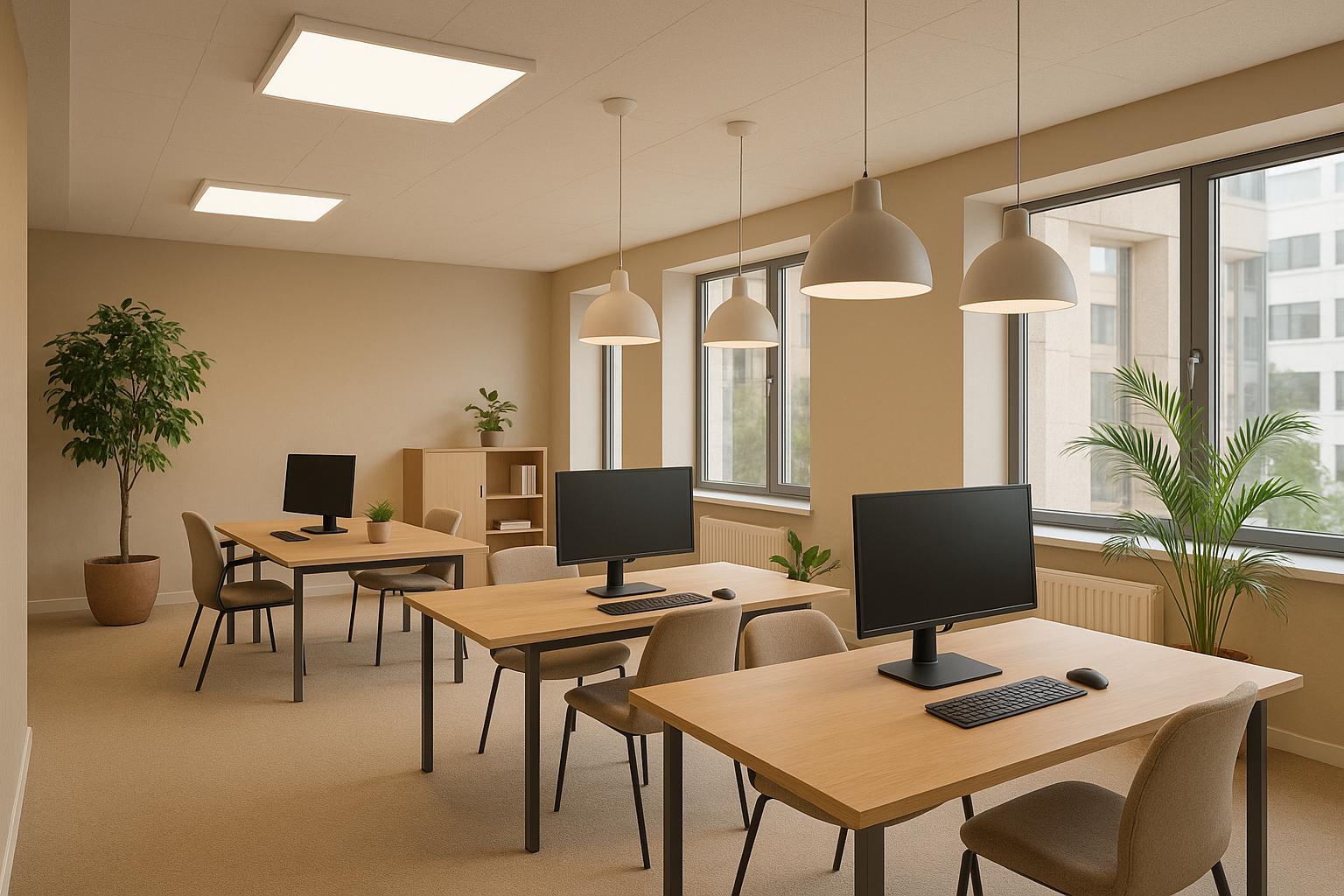

Lighting makes up 30% of Malaysia’s electricity use, offering businesses a clear chance to save energy and cut costs. Switching to energy-efficient solutions like LED systems or solar-powered lighting can reduce energy use by up to 70-80%, while also supporting Malaysia’s carbon neutrality goal by 2050. Here’s a quick breakdown of six options:
- Advanced LED Systems: Use 90% less energy than traditional bulbs, with a payback period of 18-24 months.
- Smart Lighting Controls: Automate lighting based on occupancy and daylight, saving up to 80% on energy.
- Solar-Powered Lighting: Ideal for outdoor spaces, powered by Malaysia’s growing solar capacity.
- Lighting Retrofits: Upgrade existing fixtures to LEDs, cutting energy use by over 50%.
- Energy Management Systems: Monitor and optimise energy use while simplifying ESG reporting.
- Human-Centric Lighting: Adjusts light intensity and colour to improve comfort and productivity.
Each option balances energy savings, cost, and ease of installation. Whether it’s reducing electricity bills or aligning with ESG goals, these solutions are practical for offices, warehouses, retail spaces, and more.
Quick Comparison
| Option | Energy Savings | Cost Range (RM) | Best For |
|---|---|---|---|
| Advanced LED Systems | Up to 90% | ~RM6,600,000 | Offices, warehouses, retail |
| Smart Lighting Controls | Up to 80% | RM10,000+ | Offices, smart buildings |
| Solar-Powered Lighting | 100% renewable | RM50,000+ | Outdoor and remote areas |
| Lighting Retrofits | 40-91% | RM80+ per unit | Older buildings |
| Energy Management Systems | Up to 70% | Varies | Large commercial properties |
| Human-Centric Lighting | Up to 60% | Varies | Offices, healthcare, schools |
Switching to energy-efficient lighting is not just about reducing costs – it’s also about preparing for a greener future. With government incentives like GITA and GITE, now is the perfect time to make the shift.
Indoor commercial lighting connects smart buildings | Johnson Controls
1. Advanced LED Lighting Systems
Advanced LED lighting systems are one of the quickest ways to introduce energy-efficient and sustainable lighting into commercial buildings across Malaysia. These systems not only last longer but also deliver better light quality compared to traditional lighting setups, making them a smart choice for businesses aiming to reduce operational costs.
Take the BESRAYA Highway project in October 2018, for example. By replacing High-Pressure Sodium (HPS) lamps with LED lights along a 6.4 km stretch, the project achieved energy savings of 50-60%, contributing to a 6.6% reduction in Malaysia’s total electrical consumption.
"Lighting isn’t just about flipping a switch anymore – it’s about maximizing performance, cutting waste, and future-proofing your space." – PROLIGHTING
These systems offer a winning combination of energy savings, reduced costs, and straightforward installation, making them a cornerstone for sustainable lighting solutions.
Energy Efficiency (kWh Savings)
One of the standout benefits of LED lighting is its ability to drastically cut energy consumption. LEDs use about 90% less energy than traditional incandescent bulbs.
For instance, replacing a 90-watt halogen lamp with a 14-watt LED equivalent saves 76 watts per lamp. Multiply that by hundreds or even thousands of fixtures, and the savings quickly add up.
Studies in Malaysia highlight the impressive performance of LED systems in tropical climates. A research and development building recorded annual energy savings of 72,750 kWh, 110,381 kWh, and 144,386 kWh over three phases of LED implementation. Similarly, a library in Brunei Darussalam reduced its lighting energy consumption by 6.7 times after switching to LED lighting.
Initial Cost (in RM)
While the initial cost of LED systems may seem high, the long-term savings more than justify the investment. The Malaysian Commercial LED Lighting Market is projected to grow from USD 75.4 billion in 2024 to USD 119.6 billion by 2033, with an annual growth rate of 6.2%.
With Malaysia’s commercial electricity rate set at RM0.23 per kWh, upgrading to LED lighting becomes a cost-effective choice. For example, replacing a single 400W metal halide fixture with an LED equivalent can save over RM1,200 annually in energy and maintenance costs[11].
Most LED investments have a payback period of just 18-24 months, making them one of the most economical upgrades for energy efficiency. Plus, government incentives further encourage the adoption of green technologies, reducing the financial burden of the initial investment.
Ease of Implementation
Switching to LED lighting is relatively straightforward for commercial buildings. Most LED fixtures are designed to directly replace existing lights, requiring minimal structural changes and reducing installation downtime.
For office spaces, LED panels and troffers can easily replace fluorescent fixtures using the current electrical setup. Warehouses and industrial facilities can benefit from high bay LED fixtures, which offer better light distribution and can be mounted on existing supports.
Modern LED systems also integrate seamlessly with building management systems, allowing for centralised control, scheduling, and monitoring capabilities.
Suitability for Commercial Building Types
LED lighting is versatile enough to meet the needs of virtually any commercial building type:
- Office buildings: LED panels with tunable colour temperatures and low-glare designs.
- Warehouses and industrial facilities: High bay LED fixtures with durable housings and motion sensors.
- Retail spaces: LED track lighting with high colour rendering index (CRI) for vibrant displays.
- Parking facilities: LED wall packs and pole-mounted area lighting with integrated sensors.
Each of these applications not only reduces energy consumption but also enhances operational efficiency, making LED lighting a practical choice for a wide range of commercial environments.
2. Smart Lighting Controls and Automation
Smart lighting controls and automation are reshaping sustainable lighting in commercial spaces. By leveraging intelligent sensors and advanced control systems, these solutions automatically adjust lighting based on occupancy and ambient light levels. The result? Reduced energy usage and improved visual comfort for occupants.
Today’s systems are network-based, seamlessly integrating with building management platforms. They combine features like occupancy sensors, daylight harvesting, and centralised controls to create responsive environments that adapt in real time. This progression not only boosts efficiency but also provides detailed insights into energy use and cost savings.
Energy Efficiency (kWh Savings)
Smart lighting controls excel at reducing energy consumption through automation. By using occupancy and illuminance-based controls, energy use is optimised. For instance, a digital twin system demonstrated an impressive 95.15% accuracy in operation, reducing energy consumption and cutting electricity costs by approximately 79%. Additionally, dimming strategies further enhance energy savings.
Considering that artificial lighting accounts for about 17% of total electricity usage in commercial buildings, and with electricity consumption rising by around 1.6% annually, smart controls present a meaningful opportunity to lower operational costs while aligning with sustainability goals.
Initial Cost (in RM)
While the initial investment for smart lighting systems is higher than basic setups, technological advancements have made these solutions more affordable. In Malaysia, basic smart automation packages start at around RM10,000. Here’s a breakdown of typical costs:
- Smart Package: Starting from RM10,000
- Premium Package: Starting from RM15,000
- Exclusive Package: Starting from RM25,000
For comprehensive installations, costs range from RM2,000 for basic setups to RM10,000 or more for advanced systems. Installation averages around RM6,000, while individual components like bulbs cost between RM25–RM45, and cameras range from RM65–RM329. Though the upfront expense may seem significant, the long-term energy savings often justify the investment.
Ease of Implementation
Modern smart lighting systems are built for easy integration. Wireless systems and power-over-ethernet (PoE) configurations have simplified installations. Retrofitting occupancy-based controls into existing spaces is straightforward, while illuminance-based systems require strategically placed sensors to optimise artificial lighting. A space-first approach ensures that each area gets the right setup without unnecessary components or programming. Many systems now support mobile and IoT integration, enabling remote monitoring and control through centralised interfaces.
Suitability for Commercial Building Types
Smart lighting controls can adapt to a wide range of commercial environments, offering tailored solutions for specific needs:
- Office Buildings: Integrate with building management systems (BMS) for unified control of lighting, shades, climate, and energy use. Features like occupancy tracking and space analytics enhance workforce management.
- Retail Spaces: Create dynamic lighting scenes that enhance product displays and reduce energy use during off-peak hours. Real-time monitoring provides insights into energy consumption and customer traffic.
- Hotels and Hospitality: Offer energy-efficient, intuitive environments for guests, with automated adjustments for lighting, temperature, and ambiance based on occupancy and time of day.
- Educational Facilities: Provide flexible lighting that adapts to different learning activities. Smart controls adjust colour temperature and intensity to match classroom needs and natural light.
- Healthcare Facilities: Use circadian lighting to support patient wellbeing while maintaining energy efficiency. Lighting levels can be tailored for various medical procedures and care areas.
One notable example is the Petronas Twin Towers, which implemented advanced energy management systems in 2025 to enhance sustainability and cut operational costs.
3. Solar-Powered Lighting Solutions
Solar-powered lighting systems in Malaysia are making the most of the country’s sunny climate, offering a practical way to reduce reliance on traditional electricity grids. Using photovoltaic panels to transform sunlight into electricity, these systems not only cut down on grid dependency but also align with Malaysia’s goals for sustainable energy. Since 2011, Malaysia’s solar capacity has grown from 0.1 GW to 2.6 GW, achieving a compound annual growth rate of 48%.
These systems store energy collected during the day in batteries for use at night and often come equipped with features like motion sensors, automated dimming, and remote monitoring.
Energy Efficiency (kWh Savings)
Solar-powered lighting can significantly lower energy consumption and costs. For commercial buildings, these systems can reduce energy use by as much as 40%, leading to notable savings. Here are some real-world examples:
- A restaurant and retail space in Tampin, Negeri Sembilan achieves monthly savings of RM4,500 with an 89.55 kWp solar system.
- A CNC machining facility in Sungai Buloh, Selangor saves RM8,900 monthly thanks to a 174.60 kWp system.
In a larger example, Sunway City KL generated 3,210 MWh of renewable energy in 2022 – enough to power about 443 homes annually. These examples highlight both the cost-saving potential and scalability of solar-powered lighting, particularly for large commercial projects.
Initial Cost (in RM)
While the initial investment for solar-powered lighting can be substantial, advancements in technology have made these systems more affordable over time. For commercial setups, systems with capacities above 10 kW generally start at RM50,000. A 500 kWp installation, which requires around 4,450 m², costs approximately RM2,400 per kWp.
Here’s a breakdown of typical costs:
- Small systems (3–5 kW): RM15,000 to RM25,000
- Medium systems (6–10 kW): RM25,000 to RM40,000
- Large systems (10 kW+): RM50,000+
- Inverter costs: RM3,000 to RM7,000
- Installation fees: RM3,000 to RM10,000
(Source:)
Most systems offer a return on investment within 6 to 10 years, depending on factors like energy use, system size, and government incentives. Malaysia’s Net Energy Metering (NEM) scheme allows businesses to sell surplus energy back to the grid, while tax incentives can further reduce costs. The relatively simple installation process adds to the appeal of adopting solar-powered lighting.
Ease of Implementation
The complexity of installing solar-powered lighting depends on the application. For example, solar street lights are easy to set up as they don’t need to connect to existing electrical grids. When planning installations, factors like panel efficiency, battery capacity, durability, and maintenance requirements should be considered. While integrating solar systems with existing electrical infrastructure might require more effort, the modular nature of solar technology allows businesses to start small and expand their systems over time.
Suitability for Commercial Building Types
Solar-powered lighting is versatile, making it suitable for a wide range of commercial buildings:
- Retail and shopping centres: Ideal for outdoor lighting in car parks and common areas.
- Industrial and manufacturing facilities: A plastic manufacturer in Semenyih, Selangor, saves RM11,500 monthly with a 224.77 kWp system.
- Warehouses and distribution centres: Large roof spaces can be utilised effectively; for example, a facility in Hulu Langat, Selangor saves RM400 monthly with an 8.19 kWp system.
- Office buildings and business parks: Solar lighting works well for lighting car parks, common areas, and landscaping.
- Hospitality and tourism facilities: Solar installations can enhance sustainability efforts and support green certifications.
The flexibility of solar-powered lighting not only aligns with sustainability goals but also improves operational efficiency over the long term. With Malaysia’s solar market projected to grow by an additional 4 GW in the next decade, the future looks bright for these solutions.
"Solar power is the cheapest form of new electricity in most of the world today" – Bloomberg.com
4. Lighting Retrofits and Upgrades
Upgrading to advanced LED and smart lighting systems through retrofitting provides a practical way to achieve energy savings without the need to overhaul entire infrastructures. By replacing outdated fixtures with modern LED systems, businesses can see immediate reductions in energy use and operational costs. This makes retrofitting an appealing option for Malaysian businesses, where long-term electricity savings can offset the initial investment.
Energy Efficiency (kWh Savings)
Retrofitting helps reduce energy consumption by lowering the wattage of lighting systems and optimising usage with smart controls. Studies indicate that energy savings from retrofitting can range between 22% and 91%, with LED upgrades alone delivering lighting energy reductions of over 50%.
For instance, an educational building retrofit achieved a 41% annual energy reduction. Similarly, Cenergi SEA, a leading company in energy efficiency, has saved 42,522 MWh of electricity through its projects, proving the scalability of retrofitting solutions for various commercial properties. These savings directly translate into lower utility costs and improved profitability for businesses.
Initial Cost (in RM)
The cost of lighting retrofits in Malaysia varies depending on the project’s complexity and scale. For basic installations, prices start at RM80 for the first unit, with additional units costing RM20 each. More complex tasks, such as installing new wiring or replacing switches, can range from RM30 to RM180 per unit.
These estimates typically apply to small offices or homes with ceiling heights of up to 12 feet. Commercial properties may face different pricing structures, especially if concealed wiring or other specialised requirements are involved.
Ease of Implementation
Lighting retrofits are accessible to businesses of all sizes due to their modular nature. Companies can start with simple upgrades and expand over time, allowing them to spread costs while reaping immediate energy savings. Basic fixture replacements can often be completed with minimal disruption to daily operations.
To maximise the benefits, businesses should consider conducting a Techno-Economic Analysis (TEA). This analysis evaluates energy performance and cost-effectiveness, ensuring the retrofit approach aligns with the building’s specific needs. Integrating lighting upgrades with other building system improvements can further optimise energy savings.
Suitability for Commercial Building Types
Lighting retrofits are suitable for a wide range of commercial buildings, making them a versatile solution for energy efficiency improvements. With two-thirds of existing buildings expected to remain in use by 2050, retrofitting offers a major opportunity for sustainable upgrades.
- Office buildings: These benefit significantly from retrofits, with potential energy reductions of up to 36% when comprehensive measures are implemented. The predictable usage patterns in offices make them ideal for smart lighting and LED upgrades.
- Educational institutions: Schools and universities have shown excellent results, achieving cumulative energy savings of 41% by combining multiple efficiency measures. Their long operational hours amplify the benefits of efficient lighting systems.
- Industrial and manufacturing facilities: These sectors can achieve substantial savings due to their high lighting demands and extended operating hours. Modern LED systems also handle the rigorous conditions often found in industrial settings.
- Retail and hospitality venues: Beyond energy savings, these businesses benefit from improved lighting quality, enhancing the customer experience while lowering operational costs. Retrofit solutions can help maintain the desired ambiance without compromising efficiency.
"Retrofitting is the process of upgrading or modifying existing structures, systems, or equipment to improve their performance or make them more energy-efficient." – CIDB HQ
To determine their retrofit potential, businesses should analyse energy consumption patterns using utility bills and conduct energy audits. This helps identify the most impactful upgrades and sets realistic expectations for savings and payback periods.
sbb-itb-f091f3d
5. Energy Management and Automated ESG Reporting
Energy management systems are designed to monitor real-time energy usage and Scope 2 emissions, helping businesses optimise energy consumption while supporting sustainability goals. These systems gather data from various sources, such as lighting fixtures, occupancy sensors, and environmental monitors, offering detailed insights into how energy is used and where improvements can be made.
One of their standout features is automated ESG reporting. By tracking emissions and calculating carbon reductions, these platforms simplify the reporting process, ensuring accurate and transparent disclosures. This automation not only saves time but also eliminates the need for manual data collection, creating a seamless link between energy savings and ESG compliance – a critical requirement for modern commercial buildings.
Energy Efficiency (kWh Savings)
Energy management systems, paired with upgrades like LED lighting and smart automation, significantly reduce energy consumption in commercial spaces. These systems use real-time data to control lighting and other energy-intensive systems based on occupancy and environmental conditions. In Malaysia, where lighting and HVAC systems are major contributors to energy use, integrating these technologies can reduce lighting energy consumption by up to 70%.
For instance, Resource Data Management Asia implemented an IoT-based solution that combined data from HVAC systems, lighting, and environmental sensors. By leveraging Milesight LoRaWAN technology, the system monitored factors like motion, humidity, temperature, and CO₂ levels. This allowed for intelligent control of HVAC and lighting, improving ventilation and turning off lights in unused areas.
The benefits are clear. A 100,000 sq ft (approximately 9,290 m²) office that switched from fluorescent lights to LED lighting with motion sensors reduced its lighting electricity usage by 40%, cutting over 60 tonnes of CO₂ emissions annually. Similarly, a retail chain adopting smart lighting systems across 12 locations achieved a 28% reduction in lighting-related emissions while automating their ESG reporting process.
Initial Cost (in RM)
The market for Smart Lighting Control Modules is projected to reach RM 6.75 billion by 2024 and grow to about RM 21.6 billion by 2033, with an annual growth rate of 15.5% between 2026 and 2033. Despite the high initial costs, businesses can manage expenses through phased installations and declining component prices. Starting with basic monitoring systems and gradually expanding to include advanced features like automated reporting can help spread out the financial burden. In the long run, these systems deliver significant operational cost savings, particularly in large commercial buildings.
Ease of Implementation
Advancements in technology, along with government initiatives and increased demand for energy-efficient solutions, have made energy management systems more accessible. Cloud-based platforms simplify deployment and maintenance by enabling remote control and management of lighting systems. Additionally, AI and machine learning enhance usability by predicting usage patterns and adjusting lighting schedules automatically.
However, businesses may encounter challenges such as technical integration issues, security and privacy concerns, lack of standardisation, and infrastructure limitations. Partnering with experienced providers can help address these hurdles, ensuring a smoother implementation process.
Suitability for Commercial Building Types
These systems are particularly effective in commercial buildings with high energy consumption. Older buildings and SMEs can benefit from detailed energy monitoring to achieve ESG targets and improve sustainability. Office buildings, which often have predictable usage patterns and significant lighting demands (lighting can account for 20–40% of electricity use in commercial spaces), are especially well-suited for energy management systems.
Retail and hospitality venues also gain from optimised lighting controls, which not only save energy but also enhance customer experiences. Industrial and manufacturing facilities, which typically operate for extended hours, can achieve substantial energy savings and improved ESG performance by using automated controls and detailed reporting to manage their complex lighting needs.
To get the most out of these systems, businesses should begin with an audit of their current lighting systems to measure energy usage and establish a baseline for Scope 2 emissions. Setting clear targets aligned with ESG goals – such as reducing lighting-related energy consumption by specific percentages within a set timeframe – can help ensure successful implementation and measurable outcomes.
6. Low-Glare and Human-Centric Lighting
Low-glare and human-centric lighting (HCL) systems are reshaping commercial spaces by offering light that dynamically adjusts to mimic natural daylight. These systems change intensity and colour temperature throughout the day, promoting occupant well-being and reducing eye strain.
By transitioning from cool, bright light in the morning to warm, softer tones in the evening, HCL addresses the health and productivity challenges often linked to artificial lighting in workplaces.
"Human centric lighting makes for a win-win strategy, shaping spaces where extraordinary human experiences and energy savings can co-exist, and helping construct a more sustainable environment for us all." – Craig Casery, Lutron Electronics
The global HCL market reflects its growing importance, with a valuation of RM14.5 billion in 2023 and projections to hit RM83.2 billion by 2030. This growth, driven by a compound annual rate of 29.4%, underscores the dual benefits of enhanced sustainability and improved workplace wellness.
Beyond comfort, HCL systems also offer significant energy savings.
Energy Efficiency and Savings
IoT-enabled HCL systems can reduce energy consumption by up to 60%, thanks to features like occupancy detection, daylight integration, and time-based adjustments. For instance, The Edge in Amsterdam has achieved an impressive 80% cut in electricity use. Even without such advanced systems, modern lighting solutions can lower electricity bills by 30–40% compared to traditional setups.
The China Academy of Building Research (CABR) Headquarters provides another example. Its adaptive lighting system integrates natural daylight and allows employees to personalise their lighting, further enhancing efficiency.
AI and machine learning take these savings even further by enabling predictive maintenance and fine-tuned lighting based on occupancy patterns. These energy savings can offset initial installation costs, as highlighted below.
The Cost of Investment (in RM)
The upfront cost of HCL systems depends on factors like building size, complexity, and features. While initial expenses can be high, falling LED prices and quick returns on investment are making these systems more accessible. Wireless LED technology simplifies installation, and Power-over-Ethernet (PoE) adoption further reduces infrastructure costs.
Moreover, productivity gains can justify the expense. Studies show that just a 2% productivity boost can add RM210,000 in annual value for a workforce of 100 employees earning RM105,000 annually. This shows how improved efficiency and well-being can quickly offset initial costs.
Implementation Made Simple
Modern HCL systems are easier to implement, thanks to advancements like wireless technology and cloud-based management platforms. The process typically starts with a lighting audit to identify glare and other issues. Tunable LED lights are then installed to simulate natural daylight, followed by smart controls for dynamic adjustments.
For new buildings or spaces where glare, heat, or space are concerns, OLED lighting provides a sleek alternative. OLED fixtures offer low-glare illumination, thin designs, and cool surface temperatures. However, their efficacy (21–60 lm/W) is lower than LED luminaires (100–150 lm/W). Proper encapsulation and airflow are essential to manage moisture sensitivity. Integrating sensors, timers, and smart controls further enhances functionality.
Applications in Commercial Spaces
HCL systems are particularly effective in environments where occupant well-being is a priority. Office buildings benefit from lighting that supports circadian rhythms, improving employee productivity and comfort. Educational facilities also see a boost, with students exposed to natural light showing 26% better reading outcomes and 20% higher maths performance. Circadian lighting has been shown to enhance task performance by 12%.
In data centres, low-glare OLED lighting reduces eye strain for staff working around reflective surfaces. The compact design and cool temperatures of OLED fixtures are ideal for space-constrained technical areas, with lifespans ranging from 10,000 to 40,000 hours when used in well-ventilated, humidity-controlled environments.
In hospitality, HCL elevates guest experiences by integrating lighting with window treatments and temperature controls. Dynamic lighting scenarios tailored to activities enhance both comfort and operational efficiency.
For businesses aiming to maximise the benefits of HCL, following WELL Building Standard guidelines can ensure optimal implementation.
Comparison Table
When selecting a sustainable lighting solution, it’s important to weigh the performance of each option across key metrics like energy savings, costs, and ease of implementation. The table below provides a quick comparison of the main solutions, summarising the critical points discussed earlier.
| Lighting Solution | Energy Savings | Cost Range (RM) | Implementation Ease | Best Suited For |
|---|---|---|---|---|
| Advanced LED Systems | 1,463,451 kWh (annual) | ~RM6,600,000 | Moderate | Offices, retail stores, warehouses |
| Smart Lighting Controls | Up to 80% reduction | RM29 – RM389 per fixture | Easy to Moderate | Offices, smart buildings, mixed-use |
| Solar-Powered Solutions | 100% renewable | N/A | Moderate to Complex | Outdoor areas, remote facilities |
| Lighting Retrofits | 40.59% reduction | N/A | Easy | Existing buildings, budget-conscious |
| Energy Management Systems | N/A | N/A | Complex | Large commercial complexes |
| Human-Centric Lighting | N/A | N/A | Moderate to Complex | Offices, healthcare, education |
Note: Figures are based on case studies and market examples where available.
Each solution has its strengths. For instance, smart lighting controls can cut lighting-related energy use by up to 80% through digitalisation, while lighting retrofits achieve a 40.59% reduction in energy consumption. Costs also vary widely; smart lighting components can cost as little as RM29 per fixture, but other solutions depend on project size and market conditions.
Ease of implementation often hinges on your existing setup. Lighting retrofits usually require minimal changes, making them a straightforward choice for older buildings. On the other hand, wireless smart lighting systems simplify installation by removing the need for extensive wiring. More complex solutions, like integrated energy management systems, involve significant planning and setup.
Each option serves distinct needs. LED systems are known for their efficiency and cost savings, while solar-powered solutions shine in outdoor and off-grid settings. Smart lighting offers automation and convenience, and human-centric lighting prioritises improving occupant comfort and well-being. Often, commercial spaces combine multiple solutions to maximise energy efficiency.
This table provides a concise overview to help you match the right solution to your specific commercial requirements.
Conclusion
Sustainable lighting solutions offer more than just energy savings – they also lower operational costs, enhance occupant comfort, and support Malaysia’s environmental goals. With the nation aiming for net-zero carbon emissions by 2050, commercial buildings have a critical role to play in this transformation.
The financial benefits are evident. Advanced LED systems, as highlighted in the comparison table, deliver impressive annual energy savings while aligning with Malaysia’s regulatory frameworks like the Energy Efficiency and Conservation Act (EECA) and Bursa Malaysia‘s Sustainability Reporting Requirements.
In addition to cost savings, renewable energy trends are amplifying these advantages. Solar power, for instance, is becoming more accessible. By 2050, Malaysia’s share of solar photovoltaic (PV) in total installed power generation capacity is expected to increase from 12% in 2025 to 58%, reflecting a 14% compound annual growth rate. This makes solar-powered lighting solutions a practical choice for commercial spaces.
Small and medium enterprises (SMEs) also have reasons to act promptly. In February 2024, SME Corp Malaysia launched the ESG Quick Guide to simplify ESG integration for SMEs.
Businesses can capitalise on green incentives such as the Green Investment Tax Allowance (GITA) and Green Income Tax Exemption (GITE). Partnering with lighting experts to design efficient systems and adopting phased installation plans can help manage costs while minimising disruptions during the transition. With tighter regulations on the horizon, taking early action is a smart move.
The evolving regulatory landscape further highlights the urgency of investing in sustainable lighting. Malaysia’s progress mirrors global trends, with ESG-related assets projected to surpass £30 trillion by 2025.
Whether you’re managing a small office or a large commercial property, sustainable lighting solutions offer clear financial returns and contribute meaningfully to Malaysia’s environmental targets. With proven technologies, available incentives, and strong regulatory backing, now is the time to identify the best solutions for your unique needs.
FAQs
How do Malaysia’s GITA and GITE incentives encourage businesses to adopt sustainable lighting in commercial buildings?
Malaysia’s Green Investment Tax Allowance (GITA) and Green Income Tax Exemption (GITE)
Malaysia offers two key incentives to support businesses adopting sustainable lighting: the Green Investment Tax Allowance (GITA) and the Green Income Tax Exemption (GITE).
Under GITA, businesses can claim a 100% tax allowance on capital expenditure for approved energy-efficient lighting systems. This helps reduce the initial costs of transitioning to greener solutions. On the other hand, GITE provides tax exemptions specifically for green technology service providers, encouraging the development and use of eco-friendly innovations.
These initiatives do more than just cut costs – they align with Malaysia’s broader environmental goals and ESG (Environmental, Social, and Governance) commitments. By tapping into these programmes, businesses can improve energy efficiency in their operations while playing a role in building a more sustainable future.
How can smart lighting controls help reduce long-term costs in an office environment?
Smart lighting controls can lead to noticeable long-term cost savings for office spaces by cutting down on energy use and reducing maintenance needs. By adjusting lighting based on occupancy and natural daylight, these systems can trim energy costs, saving anywhere from RM2.80 to RM4.70 per square metre annually. Over time, this can make a big difference in electricity bills.
These systems also help lighting fixtures last longer by avoiding unnecessary use, which means fewer replacements and lower maintenance expenses. On top of the financial benefits, smart lighting controls enhance workplace flexibility and security, making them a smart choice for offices across Malaysia.
How can human-centric lighting boost productivity and improve well-being in commercial spaces?
Human-centric lighting aims to replicate the natural light cycle, offering benefits that go beyond just illumination. By supporting the body’s circadian rhythm, it helps regulate sleep patterns, which can contribute to better mental health, less fatigue, and even fewer headaches.
This lighting approach also boosts focus and alertness, creating a workspace that’s not only more comfortable but also more productive. By adjusting brightness and colour temperature throughout the day, it mimics natural daylight – an especially practical feature for offices, retail spaces, and other commercial settings in Malaysia’s tropical climate.